
Home / Your Industry / Education
Protect • Community
Security & Communication Solutions for Education
In an era where school safety is a top priority, having separate “silos” for cameras, intercoms, PA, access control, sensors and two-way radio is no longer just an inconvenience. It’s a vulnerability. Integrating these systems into a single, cohesive ecosystem changes the landscape from reactive to proactive.


Integrated school safety
How it works
1. Accelerated Response Times
In an emergency, every second is a literal lifetime. When systems are integrated, a single trigger (like a panic button or a detected weapon) can initiate a chain reaction:
- Lockdown: Doors automatically bolt via the access control system.
- Alerts: Pre-recorded emergency instructions play over the PA system immediately.
- Visuals: Security cameras automatically pivot to the area where the alert originated, feeding live footage to administrators and first responders.
2. Eliminating Information Gaps
Standalone systems often require manual cross-referencing. If a “door forced open” alarm goes off in an unintegrated system, a staff member has to check the alarm log, then manually find the corresponding camera feed.
3. Streamlined Daily Operations
Integration isn’t just for “worst-case scenarios.” It makes daily life easier for staff:
- Visitor Management: Integration between the front door intercom and the security camera allows office staff to visually verify guests and unlock the door from their desk or a mobile device.
- Mass Notification: Announcements can be synced across speakers, digital signage in hallways, and push notifications to teacher tablets simultaneously.
4. Better Data and Analytics
Integrated systems provide a “single pane of glass” view of the school’s health. By combining data from different sources, schools can identify patterns, such as:
- Which exits are frequently left propped open.
- High-traffic bottlenecks during passing periods that might require more supervision.
- Vaping or noise sensors that trigger nearby cameras to identify the students involved.
Solutions
Security & communication for schools

Education
Two-Way Radio
Two-way radios are a vital tool for school safety, providing instant, reliable communication that remains functional even when Wi-Fi or cellular networks are overloaded during an emergency. They also streamline daily logistics, allowing staff to coordinate everything from playground supervision to bus loading with a simple push of a button
Learn more
Education
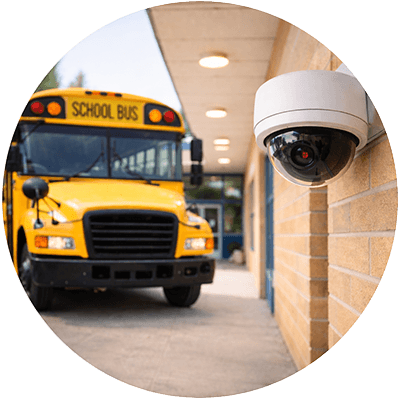
Video Security
Video security systems enhance school safety by providing real-time monitoring for rapid incident response and high-definition evidence for accurate investigations. Additionally, the presence of cameras acts as a powerful deterrent against bullying, vandalism, and unauthorized access, fostering a more secure learning environment.
Learn more
Education
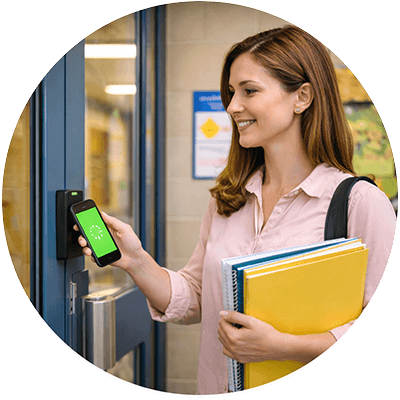
Access Control
Access control in schools is essential to ensure that only authorized students, staff, and visitors can enter the building, reducing the risk of intruders and enhancing overall campus safety. It also plays a critical role during lockdown situations, allowing administrators to quickly secure entrances, restrict movement, and maintain tighter control to protect students and staff in an emergency.
Learn more
Education
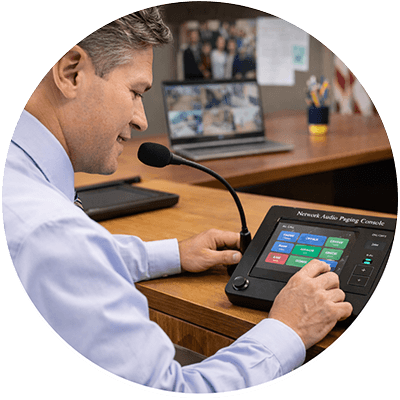
Network Audio
An ONVIF network audio PA system is important in schools because it enables seamless integration with security cameras and access control systems, creating a unified safety and communication platform. It allows administrators to quickly broadcast live or automated announcements across specific zones or the entire campus, which is critical for everyday communication as well as emergency and lockdown situations.
Learn more

Education
UCaaS / VoiP
VoIP systems transform school communication by integrating multiple campuses into a single, unified network that can be managed from any location. They also offer significant cost savings by eliminating traditional phone lines and providing advanced features like “paging-to-all” for instant, school-wide emergency broadcasts to integrated ONVIF PA system.
Learn more

Education
Cellular Enhancement
Installing a cell signal booster in a school with poor cell service ensures reliable communication for staff, parents, and emergency responders when it matters most. Strong cellular coverage also supports mobile safety apps, two-factor authentication, and coordinated response during emergencies or lockdown situations.
Learn more
School phones
School phone systems that work with your PA
A phone that only works at the front desk is not enough for a school. Teachers, principals and office staff need to reach parents, colleagues and the entire building, and they are rarely sitting still when they do. With a school phone system, the school’s number rings on a desk phone, a cordless DECT handset or a mobile app, so staff can be reached anywhere on the grounds.
The same system can work with the PA, bells, paging and intercom the school already uses. That helps with everyday announcements, and with getting an emergency or lockdown message to the building at the same time.
- One school number, everywhere on campus: Staff can take calls at a desk, on a cordless handset or on a mobile app, so a parent or colleague can reach them without knowing which room they are in.
- Works with your PA, bells, paging and intercom: Class changes, announcements and urgent messages can go out over the speakers and intercoms the school already has, rather than replacing them.
- Emergency alerts and lockdown notification: When something goes wrong, staff need a short path to help and a way to tell the building the same thing at the same time.
- Video classes and multi-site districts: The same system can support remote and hybrid teaching, and help a principal or office team stay reachable across more than one campus.
- Cell signal in concrete school buildings: Staff mobile phones, and the school line on a mobile app, only work if there is signal inside the building. A cell booster or DAS can fill those dead spots.
Partners
Our Brands





















Get in touch
Questions about school safety and communication?
If you have any questions or comments we would be pleased to hear from you. Call our customer service team or send us a message and one of our experts will be in touch.
- Call1-855-859-4266
1.855.85.WICOM - Emailsales@wicom.ca
Send us a message
Quotes, rentals, programming or service: tell us what you need.